Mitja (Mitya) Goroshevsky walks listeners through the rocky, rewarding process of launching Acki Nacki’s mainnet: the scheduling delays, node sales and onboarding, the hard engineering that produced sub-second finality, and the broader design choices behind a probabilistic Proof‑of‑Stake protocol aimed at pushing blockchain performance to its physical limits.
He discusses tokenomics inspired by Bitcoin’s economic dilemmas, the architecture that separates block propagation from execution verification, mobile mining via Popit games, privacy-focused trading (Dark Order DEX), enterprise partnerships, and use cases ranging from biodiversity tokens to real‑time gaming.
Launch story: not as planned, but resilient
Acki Nacki’s mainnet launch was a long haul. The team originally targeted a late‑February release but had to postpone due to funding and paperwork, and, more importantly, the logistics of a “super fair” launch: selling nodes and tying them to node providers across multiple data centers. What looked like money in the bank still required six months of operational work: hardware provisioning, documentation, signing agreements, and ensuring distributed infrastructure could run reliably.
When the network went live it did so with strong decentralization: roughly 250 nodes across three continents, hosted in different data centers. The infrastructure team achieved impressive reliability: sustained average finality around ~750 ms and no crashes or outages from the infra layer in the first two months.
Key operational takeaway: raising funds early doesn’t mean you’re operationally ready. Launching a decentralized, high‑performance network requires extensive coordination with node owners, data‑centre partners, and robust DevOps.
Users, activity, and product focus
Rather than chasing MAU/DAU metrics, Acki Nacki prioritizes the stability and quality of network operation. At the time of the discussion there were roughly ~20,000 active miners/users interacting with the system; 2 million smart‑contracts had already been deployed. Average TPS seldom fell below 30, and empty blocks were rare, a sign of consistent user demand.
A key challenge is converting non‑crypto users into crypto‑native users. Acki Nacki’s early adopters include many people with little previous crypto experience, drawn by games and lightweight wallet flows. The team recognizes the onboarding friction: installing a traditional wallet as a separate app proved impractical for many users, so they emphasize in‑app/lightweight wallet approaches (e.g., ZK‑login) to bridge this gap.
Where Acki Nacki sits in the blockchain landscape, a single thesis
Acki Nacki’s positioning is built on the belief that blockchains are far from mature. While many databases have reached a point of diminishing returns for their use cases, blockchains remain orders of magnitude away from saturating the possible performance envelope.
Acki Nacki’s core thesis: build a blockchain so fast and parallel that, under current hardware and bandwidth limits, it becomes hard to increase throughput much further. That unlocks use cases that no current public chain can support: microsecond‑sensitive games, enterprise systems requiring tens of thousands of TPS, and real‑time ordering systems.
This approach intentionally avoids pigeonholing Acki Nacki as either a purely consumer or enterprise chain; the same high throughput and low latency are attractive across sectors.
Tokenomics: modeling Bitcoin’s economic dilemmas on PoS
One of the most original parts of Acki Nacki is its tokenomics: an attempt to emulate the economic properties of Bitcoin (a Proof‑of‑Work store of value) within a Proof‑of‑Stake environment. Mitja frames the problem: Bitcoin’s economics benefit from hard, illiquid investment (ASICs + electricity) that create persistent economic friction, miners face real costs and dilemmas (keep mining at a loss or stop). Typical PoS systems make it trivial to sell stake and walk away, so they lack analogous friction.
To compensate, Acki Nacki designs mechanisms such as a min‑stake curve and float compression so that exiting the mining ecosystem creates a meaningful dilemma: either stay fully committed or exit completely. The min‑stake grows over time and is closely coupled to the emission curve, compressing the tradable float so that selling becomes an all‑or‑nothing decision. The result is an economic tension that more closely mirrors Proof‑of‑Work dynamics and encourages long‑term stake commitment.
The team produced a dense, math‑heavy tokenomics document to prove the mechanics and calibrate parameters.
Consensus architecture: probabilistic PoS that borrows Raft ideas
At the heart of Acki Nacki is a novel probabilistic Proof‑of‑Stake consensus that asks: can a Raft‑like efficient two‑round protocol be made Byzantine‑resilient and decentralised? The core design choices and roles are:
- Block producer (leader): a long‑running sequencer that issues blocks frequently (target block times cited at ~300 ms).
- Block keepers: recipients of the block headers; they ACK simple header checks (not execution).
- Block verifiers (Acki/Nacki): a randomly selected subset (via local coin from BLS-key and block hash) that actually executes/validates transactions and emits ACK/NACK.
Key properties:
- Keepers perform header validation and ACK quickly to minimize message rounds.
- A verifier selection is local and private (each keeper computes independently using their private BLS key + block hash), eliminating a global randomness beacon and the associated RANDAO attack surface.
- The system trades deterministic BFT guarantees for probabilistic guarantees (similar in spirit to Nakamoto consensus). Network parameters let operators choose the desired security/latency trade‑off (more verifiers → lower attack probability → more overhead).
A block becomes finalized once the block producer collects a configured percentage (node‑count based, not stake‑weighted) of attestations. Sybil prevention is enforced through min‑stake requirements: nodes must lock enough stake to join the pool.
Mitja’s philosophical stance: determinism at the consensus level is an unnecessary fetish when cryptographic elements and socio‑economic layers are already probabilistic.
Randomness and manipulation resistance
Acki Nacki avoids shared randomness: each keeper independently decides whether to be a verifier based on private computations (BLS signatures + block hash). That design makes it infeasible for the leader to craft a block to predict which verifiers will be selected, removing a large attack surface. Key‑regeneration attacks are equivalent to brute‑forcing private keys and are impractical with modern cryptography.
Censorship and inclusion: RPC nodes as actors
To improve censorship resistance, Acki Nacki introduces RPC nodes (block managers) as part of the consensus ecosystem. These nodes help deliver user transactions and sign them; for this service they receive a fraction of block rewards (10%). Users can switch managers if they face censorship, creating a marketplace for transaction delivery and a mechanism to mitigate localized censorship by individual producers or indexers.
Privacy, the Dark Order DEX, and TEEs
Acki Nacki announced Dark Order DEX (dex.do), a fully private order‑book exchange. It combines:
- A ZK‑style shielded settlement (lighter than full Zcash-style trees because the chain is content‑addressed),
- Per‑pair WASM order‑book contracts that execute like traditional exchanges (one WASM per trading pair), and
- TEEs that provide order‑preserving encrypted price labels and epoching to prevent statistical de‑anonymization.
This engineering trade‑off favors microsecond execution and real‑time matching (TEEs + encryption) over fully fledged ZK proofs, with the TEE acting as a privacy oracle for prices. The team views TEEs as a pragmatic intermediate step toward broader cryptographic privacy solutions.
Games, mobile mining, and Popit mechanics
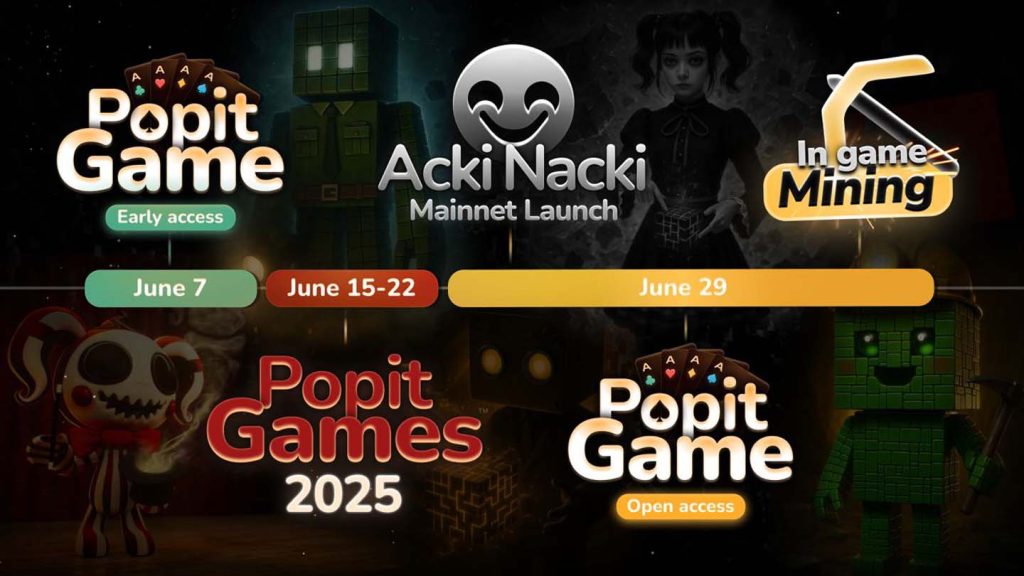
Acki Nacki’s consumer‑facing growth engine is Popit, a mobile game that doubles as a mining mechanism. Players mint and tap Popits; the top 1% of Popits in a time window are minted and receive a share of the mobile verifier emission. Key design points:
- A significant portion of emission is earmarked for Mobile Verifiers (22.5% in internal docs).
- Rewards for a minted Popit are calculated from emission since the last mint and split among tappers, weighted by in‑game upgrades (Mamaboard level) and tap count.
- Anti‑bot measures and cryptographic puzzles make taps nontrivial, tapping performs light cryptographic work and parallel‑tap protections penalize bots.
Popit, combined with lightweight wallets (ZK‑login), creates a path to onboard mainstream users who never previously used a crypto wallet.
Partnerships and enterprise use cases
Acki Nacki engaged with major cloud and enterprise vendors, notably Oracle. Although Oracle Cloud wasn’t a perfect fit (optimized for AI/ARM stacks), Oracle still assists in positioning Acki Nacki for enterprise and government customers where high throughput and public attestations are required. Other infrastructure partners include OVH and NetX; many validators run on their own bare metal for performance and cost reasons.
Enterprises are interested in unique high‑throughput cases like supply‑chain telemetry and biodiversity credits (the latter extends carbon credits to whole ecosystems and measurable biodiversity tokens for regulatory compliance).
Developer tooling and migration story
Git‑on‑Chain (GOSH) began as the motivating use case, pushing millions of git objects crashed other chains. Acki Nacki’s capacity to handle large parallel workloads makes it a natural home for those workloads, and a migration path from centralized testnets to Acki Nacki mainnet is planned.
The developer stack includes WASM smart contracts, per‑pair order book WASMs for the DEX, and plans for B‑Engine for mobile game developers to embed mining logic easily.
Practical notes, known limitations, and next steps
Shell (compute token) on‑ramps were delayed at launch (USDC path required) but were expected to be resolved within weeks.
- Contract deployments were temporarily gated until Shell buyability and USDC on‑ramps were live.
- Finality mechanics allow blocks to be produced every ~300 ms even under duress, while finality may lag and revert bad blocks until adequate attestations accumulate.
Roadmap highlights: DEX launch and waitlist (dex.do), expanding Popit features and baskets for fairer mobile mining, better wallet on‑ramp UX, and more enterprise integrations.
Closing: can it win mainstream adoption?
Mitja’s candid perspective: superior technology is necessary but not sufficient (Betamax vs VHS). The team believes they have removed many fundamental technical barriers, sub‑second finality, huge parallelization, and a PoS tokenomics model designed to mimic long‑term incentives, but adoption still depends on product, UX, regulatory clarity, and the unpredictable market.
The core technical claim stands: there’s no fundamental barrier to 300 ms blocks, sub‑second finality, or orders‑of‑magnitude increases in TPS using Acki Nacki’s design. The next steps are product execution, developer tooling, and broadening the user base via games and low‑friction wallets.